Survival as a Strategy: How to Keep Your Money in a Crazy World
by admin - 22-06-2026The biggest trick to making money is that the skills you need to get rich are totally different from the skills you need to stay rich. To build wealth or make a good investment, you have to take risks and really work for it.
But to keep that money or stay wealthy, you need a completely different mindset. And this is where most people and investors lack knowledge. Most books and thoughts work around how to make money and generate wealth, but there is very little about how to remain wealthy.
Why this is relevant today? Looking around at the world right now in mid-2026, this isn't just theory—it is real life. Markets are wild, the news is stressful, and the old rules don't seem to work like they used to.
And the need of the hour is not just getting rich but staying rich
WHAT IT TAKES ?
Author Morgan Housel summarizes this perfectly:
Getting rich requires taking risks, being optimistic, and putting yourself out there. But staying rich requires the opposite of taking risks. It requires humility, and fear that what you’ve made can be taken away from you just as fast.If you want your money to survive this era, you have to learn how to be a Bi-modal Thinker.This is a fancy way of saying you need to be two things at the same time: a long-term optimist (believing things will work out well in the end) and a short-term paranoid realist (worrying about what could go wrong tomorrow).
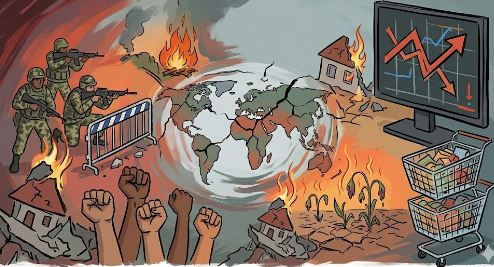 THE MESSY PRESENT: WHAT'S HAPPENING IN THE WORLD RIGHT NOW ?
To see why just surviving is number one goal right now, one only have to look at the daily news.
The global economy is going through a very rocky patch, driven by a few major issues:
1. Wars and Geopolitical Tension
Fighting in the Middle East and broken diplomatic talks have made global trade unpredictable. Crucial shipping routes are facing delays, which keeps oil prices bouncing up and down. For India, which buys most of its oil from overseas, expensive oil quickly makes everything else from transport to groceries more costly.
2. High Inflation and Interest Rates
Everyone hoped that prices would stop rising by now, but inflation is proving to be very stubborn. Because things are still expensive in places like the US and Europe, central banks are keeping interest rates high. When interest rates are high over there, big foreign investors pull their money out of developing markets like India and take it back home to safer US dollar accounts.
3. The Recent Stock Market Drop in India
Because of all this global pressure, the Indian stock market has had a very tough start in 2026. We have already seen huge volatility and wealth destructions resulting complete loss of trust and faith in investing. Investors are more worried about sustainability and fatigue that was borned because of the persistent FIIs selling.
MAKING MONEY VS. KEEPING MONEY: TWO DIFFERENT GAMES
Most people lose their hard-earned savings because they forget that making money and keeping money require two totally different playbooks. Making money requires an offensive game. Keeping money requires a defensive game.
Look at history's famous trader, Jesse Livermore. Back in 1929, he made a mind-boggling fortune of $100 million by betting against the stock market right before the Great Depression crashed it. He was one of the richest men alive.
But he only knew how to play offense. He kept taking giant risks and using borrowed money. Within a few years, his entire fortune vanished,and he lost absolutely everything. He was amazing at getting rich, but terrible at staying rich.
Now, compare him to Warren Buffett. Buffett is famous for keeping a mountain of cash—often over $150 billion—just sitting safely in short-term government bonds. During a booming market, critics always tell him he is being lazy and wasting that cash. But Buffett knows that having extra cash means his company will always survive any crisis. And when a crash finally happens and everyone else is panicking to sell, Buffett uses his safe cash to buy great businesses at bargain prices.
As Morgan Housel points out:
"A margin of safety is a recognition that emotion, not logic, drives the world, and that you cannot predict what will happen next. It is the only effective way to navigate a world that is completely unpredictable."
How to Think Like a "Paranoid Optimist"
So, how do you actually apply this advice to your own bank account when the markets are dropping?The Short-Term: Be a Paranoid Realist
In the short term, you must assume that anything can go wrong. Markets can drop, bad news can break out overnight, and prices can go crazy.
Being paranoid in the short term means arranging your money so that if the stock market crashes tomorrow, you don't care. Ask yourself: If my investments drop for the next six months,do I have enough plain cash in the bank to buy groceries and pay my bills? Survival means making sure you are never forced to sell your stocks at a loss just because you ran out of cash.
The Long-Term: Stay a Deep Optimist
At the same time, you must believe that over 5, 10, or 20 years, things will get better. History shows that despite wars, recessions, and crises, human beings solve problems. Businesses adapt, countries grow, and economies recover. Large investment firms note that while wars and high oil prices hurt markets in the short term, the Indian stock market has always bounced back stronger after these stressful periods pass. A long-term optimist looks at a market drop not as a disaster, but as a big clearance sale to buy good assets for cheap.
 SIMPLE RULES TO KEEP YOUR PORTFOLIO SAFE
Here are three simple rules to make your money safer today:
1. Keep an Inefficient Cash Cushion
Don't try to invest every single rupee you own to get maximum returns. In a fragile world, boring cash is your best shield. Keep enough money in a regular bank account or safe fixed deposits to cover your living expenses for at least a year or two. This ensures that when the stock market takes a sudden 5% dip, you can sleep easily knowing your real-world life is fully paid for.
2. Don't Put Short-Term Money into Long-Term Investments
If you need money to pay for a wedding, a house deposit, or a business bill within the next two years, that money should never be in the stock market. Equities are wild beasts. Only invest money that you are 100% sure you won't need to touch for the next 5 to 10 years. Give your money time to ride out the storms.
3. Diversify Even When It Feels Boring
When one specific type of investment is booming, spreading your money around feels like a drag. But when global crises hit, having your money in a few different places (like regular stocks, safe government bonds, gold, and cash) is what keeps you afloat. If one door closes,another one stays open.
The Ultimate Reward of Just Staying Alive
When we look at legendary investors, we think they got rich because they were geniuses who picked the perfect stocks. But the real secret is that they just didn't quit or get wiped out for 50 years. Their money grew because it had decades to multiply without being interrupted by a disaster. You can't grow your wealth if you don't survive the bad times.
TO END WITH ANOTHER GREAT THOUGHT FROM MORGAN HOUSEL :
The ability to do what you want, when you want, with who you want, for as long as you want, is an incredible ROI. But that ROI is completely unavailable to those who cannot survive the unavoidable chaos of the short term.
The market drop we are seeing right now isn't the first time the world has looked scary, and it won't be the last. It is just another test. By tuning out the daily panic, keeping some extra cash handy, and trusting that the future will be bright, you protect your hard-earned savings.
In the grand game of investing, you don't need to hit a home run every single day. You just have to make sure you never get knocked out of the game or staying on the pitch protecting the wicket.
_________________________________________________________________
10-Days Certification Course on "Crowd Psychology"
(Read online 5 minutes a day)
Understand how people think, feel & act in groups — and transform your leadership, strategy, and decision-making.
🧠 You Will Learn:
- 🧍♂️ Crowd behaviour: how they think and act together
- 😨 How crowd emotions turn into crisis
- 🙌 How to better handle crowds and large social gatherings
- 🎯 What influences a crowd and how it’s shaped
- 🗣️ How great leaders and social groups shape crowd thinking
- 🚫 How not to get trapped in crowd behavior
- 💡 Discounted price of just Rs 499 (get refund if you do not like course)
Enroll now 👉 Click here
.jpg)
📘 This Course Includes:
- 🧩 10 chapters only (English)
- 📲 1 chapter delivered every 3 days via WhatsApp/Email
- ⏱️ Just 15 mins/day to complete the course in 30 days (Total ~1.5 hrs)
- 📱 Learn on Mobile/Desktop
- 🏅 Certificate of Completion on Day 30
💰 ₹ 2999 pay now Only! 499 RS🔥🔥🔥🔥
👥 Who Should Attend:
📈 Stock market investors, 🎓 Students, 👨💼 Team Leaders, 🎯 Marketers, 🏢 Business Owners.
✅ Real-life Examples | Designed for Busy People | Certificate for your LinkedIn/Resume
🔗 Enroll now 👉 Click here
100Bagger: Eagle Post
Aimed at compounding knowledge and wealth, we bring to you best stories and resources every month handpicked by our 100 Bagger team.
- Bonus: You'll also receive a FREE COPY of our latest ebook, "MARKET CYCLES: HOW THEY WORK AND HOW TO PROFIT FROM THEM"
- E-copy of Highlighted 45 Page Detailed Naval Ravikant Interview
- Book Summary "The 4-Hour Work Week"