Skating to Where the Puck Is Going: What Indian Investors Can Learn Right Now
by admin - 12-09-2026For the last two or three months, Indian stock markets have had a rough time. There's been a lot of noise — tariff threats from the US, foreign investors pulling money out, crude oil prices climbing because of tension in the Middle East, and bond yields going up around the world.
The Nifty just went through its longest losing streak in about 11 months, seven straight sessions of red before it finally snapped back recently.That bounce back happened for a few simple reasons. US bond yields cooled off a bit after the US Treasury said it would buy more long-term government debt, which calmed nerves globally.
Traders who had bet against the market started covering their positions. And foreign investors, who had been selling for weeks, started buying again. The gains that day were broad — most sectors closed in the green, not just one or two pockets of the market.
Now, is this proof that everything is fixed? No. Nobody can say for sure that the worst is fully behind us. Crude oil is still elevated. Geopolitical risk hasn't gone away. But there are enough signs — cooling bond yields, FIIs coming back in, broad-based buying across the market, earnings cycle recovery, capex cycle on a rising trend — that suggest the panic phase of the last few months might be behind us.
Without predicting where markets are going to be next, what matters now is where we place our bets from here.
The Wayne Gretzky Idea
Wayne Gretzky, probably the greatest ice hockey player ever, once said something that has become one of the most quoted lines in business and investing:
"I skate to where the puck is going to be, not where it has been."
That's it. That's the whole idea. Gretzky wasn't the fastest skater on the ice. He wasn't the strongest. But he was almost always in the right spot at the right time, because he wasn't chasing the puck — he was predicting where it would go next and getting there first.
In investing, this works the exact same way. Most people invest based on what's already doing well. They see something that's up 40% this year and jump in, thinking the trend will just continue.
But by the time something is obviously doing well, a lot of the "easy" money has usually already been made. The real skill in investing isn't spotting what's hot today — it's building a habit of asking where growth, profits, demand, or capital is headed next, and getting positioned there before everyone else catches on.
Warren Buffett said something that captures a similar spirit, just from a different angle:
"Be fearful when others are greedy, and be greedy when others are fearful."
Buffett's point is basically this — the crowd is usually looking backward, reacting to what just happened. If you want real returns, you often have to think differently from what feels comfortable at the time.
Rakesh Jhunjhunwala, often called India's own Warren Buffett, believed that being wrong about the market for a while is fine, but staying wrong out of stubbornness is not something a good investor can afford.
His whole approach was built on staying invested in the country's long-term growth story, even when short-term noise made things look scary. That mindset lines up exactly with the puck idea — not reacting to the last three months, but thinking ahead to the next few years.
It is the Puck Not the Picks
The whole point of the "puck" idea is that it's a way of thinking, not a shortcut to an answer. If we just handed you three sector names, you'd be relying on someone else's judgment instead of building your own — and that habit runs out the moment the environment changes and those names stop working.
So instead, here's what the process of "skating to where the puck is going" actually looks like in practice.
 Step 1: Separate what's temporary from what's structural. When you look at what pulled the market down over the last few months, ask which of those pressures are likely to fade on their own — negotiations settling, weather-related supply issues resolving, a rate decision passing — versus which ones reflect something that will still matter two or three years from now. The temporary stuff is usually "where the puck has been." The structural stuff is where you want to spend your attention.
Step 2: Look at where money and policy are already quietly moving. You don't need insider information for this — a lot of it is public. Government budget priorities, regulatory changes, capital expenditure trends, and what large domestic institutions are doing with new money are all published information. These flows tend to move before stock prices fully reflect them.
Step 3: Ask what a country of India's size and demographics will need more of, not less of, over the next decade. This isn't about picking a sector — it's a mental exercise. What does a growing, young, increasingly urban population consistently need more of over time? What tends to get built out as an economy matures? You don't have to answer this with a specific name. The point is to practice thinking in years, not in days.
Step 4: Compare price against your own read of the future, not against what the price did last week. A lot of retail investors accidentally use "the price already moved, so I missed it" or "the price already fell, so it must be cheap" as their only signal. Neither of those tells you much about where things are actually headed. Gretzky wasn't looking at where the puck had just been to decide where to skate — he was reading the play.
Step 5: Build in time and patience as part of the plan, not as an afterthought. Positioning ahead of a trend usually means being early, and being early often looks like being wrong for a while. That's normal. The skill isn't just spotting the direction — it's being able to sit with some discomfort while the rest of the market catches up to what you already saw.
Step 6: Revisit your reasoning, not just your returns. Every few months, go back to why you made a decision in the first place. If the reasoning still holds even though the price moved, that's useful information. If the reasoning has quietly stopped making sense, that's useful information too — regardless of whether the position is currently up or down.
None of these steps will hand you a name to buy. What they will do, over time, is build the muscle of thinking ahead of the crowd instead of reacting to it — which is really the entire point of the Gretzky idea in the first place.
Why Timing This Matters Right Now
 After a rough two or three months, a lot of retail investors tend to do one of two things — they either panic and pull out completely, right near the bottom, or they wait for "full confirmation" that everything is fine before getting back in, by which point a lot of the recovery has already happened.
Both of these are examples of chasing the puck instead of skating to where it's going.
The smarter approach, in line with the Gretzky mindset, is to use periods like this — where there's still some uncertainty, but early signs of stabilizing are showing up.
John Templeton, another legendary investor, used to say that bull markets are born in pessimism and die in euphoria. If that's true, then a market that's just come off a rough three-month stretch, still nursing some doubts, is a very different — and often more useful — place to be doing this kind of thinking than one that's already euphoric and where everyone already agrees on the story.
The Bottom Line
Nobody can promise that Indian markets have fully turned the corner. There are still real risks — oil prices, global tension, and the usual unpredictability of tariff policy.
But the goal was never to wait for certainty, and it was never to hand out a shortcut list either. It's to notice when enough of the picture is changing, and to have a process ready for figuring out what that means for you.
_________________________________________________________________
10-Days Certification Course on "Crowd Psychology"
(Read online 5 minutes a day)
Understand how people think, feel & act in groups — and transform your leadership, strategy, and decision-making.
🧠 You Will Learn:
- 🧍♂️ Crowd behaviour: how they think and act together
- 😨 How crowd emotions turn into crisis
- 🙌 How to better handle crowds and large social gatherings
- 🎯 What influences a crowd and how it’s shaped
- 🗣️ How great leaders and social groups shape crowd thinking
- 🚫 How not to get trapped in crowd behavior
- 💡 Discounted price of just Rs 499 (get refund if you do not like course)
Enroll now 👉 Click here
📘 This Course Includes:
- 🧩 10 chapters only (English)
- 📲 1 chapter delivered every 3 days via WhatsApp/Email
- ⏱️ Just 15 mins/day to complete the course in 30 days (Total ~1.5 hrs)
- 📱 Learn on Mobile/Desktop
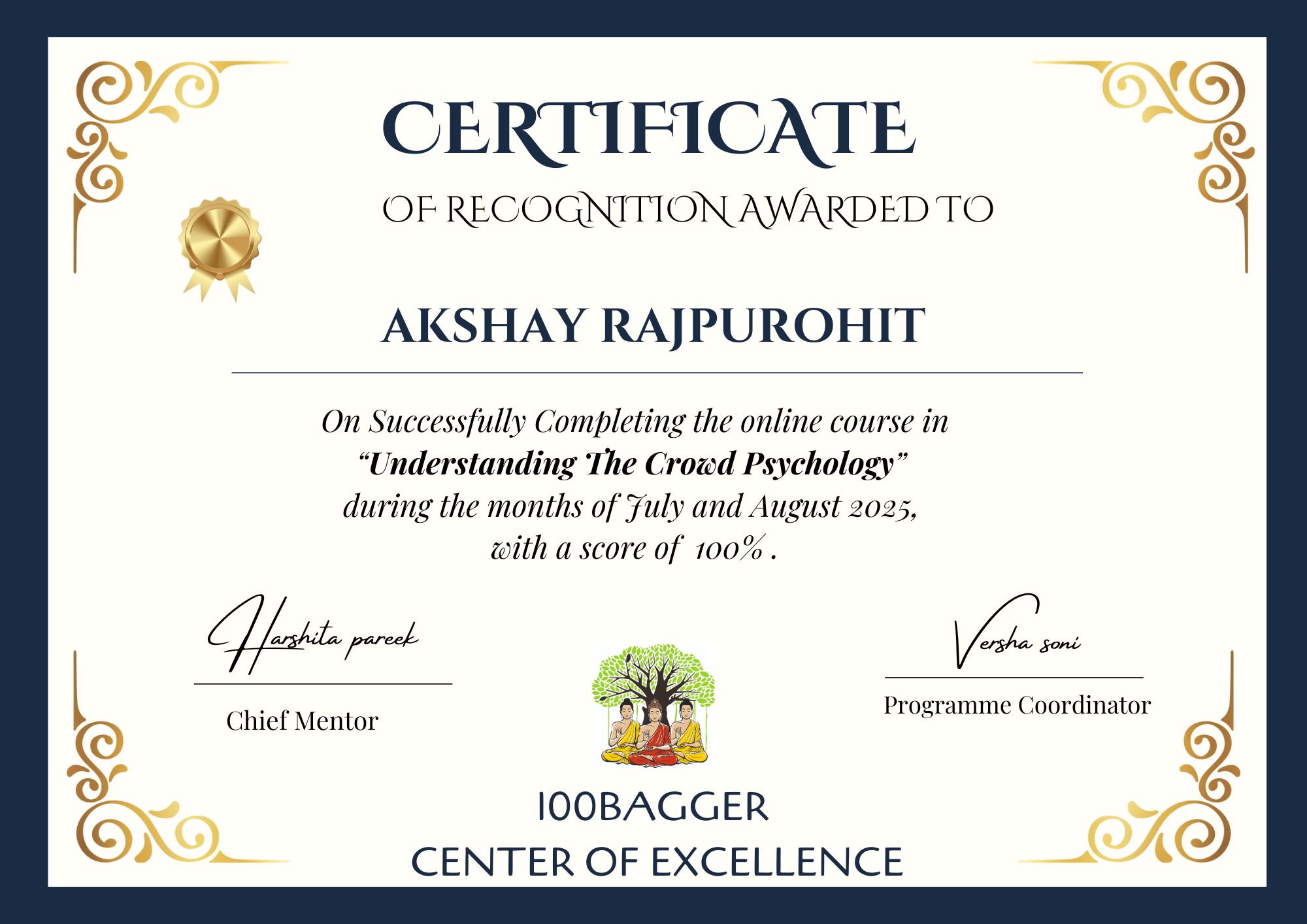
- 🏅 Certificate of Completion on Day 30
💰 ₹ 2999 pay now Only! 499 RS🔥🔥🔥🔥
👥 Who Should Attend:
📈 Stock market investors, 🎓 Students, 👨💼 Team Leaders, 🎯 Marketers, 🏢 Business Owners.
✅ Real-life Examples | Designed for Busy People | Certificate for your LinkedIn/Resume
🔗 Enroll now 👉 Click here
100Bagger: Eagle Post
Aimed at compounding knowledge and wealth, we bring to you best stories and resources every month handpicked by our 100 Bagger team.
- Bonus: You'll also receive a FREE COPY of our latest ebook, "MARKET CYCLES: HOW THEY WORK AND HOW TO PROFIT FROM THEM"
- E-copy of Highlighted 45 Page Detailed Naval Ravikant Interview
- Book Summary "The 4-Hour Work Week"